*

Announcement


  • Lucien Chaffa presents at the 63rd annual conference of the SCSE

    Lucien Chaffa presents at the 63rd annual conference of the SCSE

    Event

    Lucien Chaffa presents at the 63rd annual conference of the SCSE

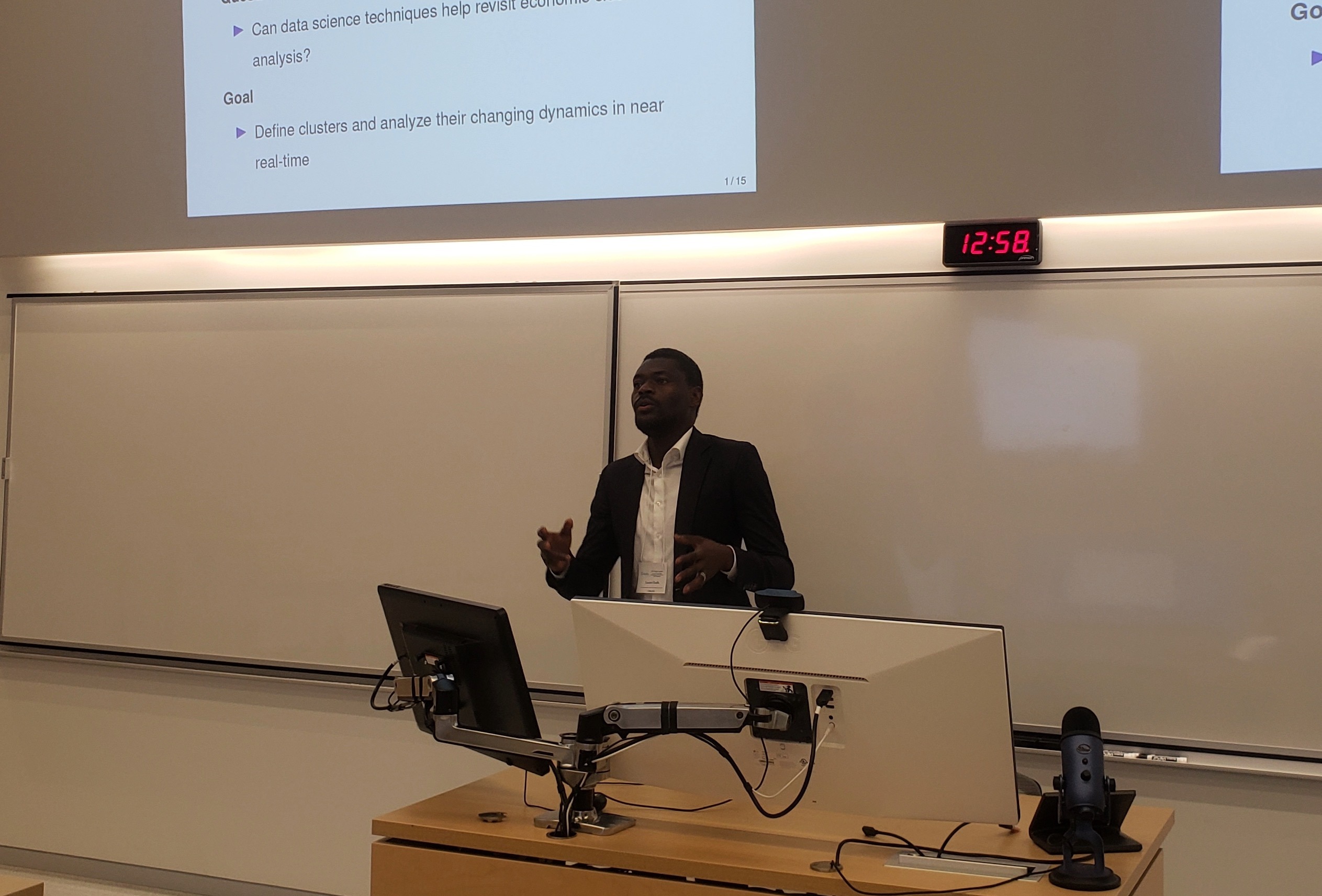
    On May 17, Lucien Chaffa presented his paper, co-authored with Thierry Warin, titled “Deciphering Economic Clusters in Real-time: Applying Machine Learning to Registre des entreprises du Québec Data” at the 63rd annual conference of the Société canadienne de science économique (SCSE). This event marks a major milestone for us as it showcased preliminary findings from our very first research paper to a group of eminent academics.

    Economic clusters are an integral dimension of our economic analysis in the bi-national St. Lawrence – Great Lakes region. Firms from an industry form linkages with firms from other industries, resulting in them colocating with each other. The grouping of industries into such clusters is useful to better understand the structure of regional economies and the industrial dynamics within them. Identifying the presence of clusters and subsequently analyzing their industrial composition, highlights the hidden interdependencies between firms and their economic impact at a very granular scale.

    Clusters have become a household tool for policymakers to enhance regional competitiveness. Yet, cluster theory and its definitions have often relied on a qualitative, case-study driven approach where empirical data is used to validate hypotheses in a region-specific context. With this paper, we operationalize our inductive approach by using data science methods to revisit economic phenomena. By using firm level data from the Registre des entreprises du Québec, we create a new quantitative measure to define clusters and analyze their changing dynamics in near real-time.

    The methodology and findings of this research paper will soon be published on our website. We invite you to refer to the following presentation for more detailed insights.

    Speaker(s)

    • Aïchata S. Koné

      CIRANO & GVCdtLab

    • Thierry Warin

      HEC Montréal, CIRANO, GVCdtLab & Digital Data Design (D^3) Institute at Harvard Business School

  • Introducing the SLGL dataHub

    Introducing the SLGL dataHub

    Event

    Introducing the SLGL dataHub

    On March 21, CIRANO’s Pole on Data Science for Trade and Intermodal Transportation held its annual conference on the theme of Data Science for St. Lawrence – Great Lakes: Innovation and Collaboration. The event brought together stakeholders from the government, industry, and academia, from both Canada and the US. The speakers presented and discussed how data science could help solve key trade and transportation issues in the binational St. Lawrence – Great Lakes (SLGL) region.

    The changing geopolitics, recovery from the COVID-19 pandemic and the rapidly evolving effects of climate change have enveloped the pace of globalization and its networks with tremendous uncertainty. With a combined current-dollar GDP of over $7.9 trillion in 2022, the SLGL region is an economic powerhouse with significant potential for sustained growth.

    The region offers policymakers an enticing opportunity for cross-border collaboration in delivering a stable and prosperous business environment in an increasingly challenging global landscape. Strengthening the resiliency of supply chains and devising a plan of action for disruptions to the region’s multimodal transportation network are essential steps toward this goal.

    The SLGL dataHub, an analytics platform and database, is being designed and developed to fulfill this very need. Our team presented an early version of the SLGL dataHub to the audience in attendance, showcasing the capabilities of digital twins in breaking down complexity with the use of data science.

    Using real-time data to create a digital projection of the bi-national economy, the SLGL dataHub will offer users granular firm-level insights and analysis. We study this region through four dimensions of international business literature which includes global value chains (GVCs), economic clusters, economic complexity and the gravity model.

    The digital twin uses advanced machine learning models to offer predictive modelling and risk analysis. By simulating scenarios such as blockades at important routes of international trade or port infrastructure being rendered inaccessible due to rising water levels, the SLGL dataHub will be able to effectively quantify impact on trade and transportation networks from such disruptions.

    Access to high quality and relevant data is a key factor influencing the efficacy of these simulations, which we continuously seek as we develop the SLGL dataHub.

    The SLGL dataHub will be made available to users in the coming weeks.

    Speaker(s)

    • Aïchata S. Koné

      CIRANO & GVCdtLab

    • Thierry Warin

      HEC Montréal, CIRANO, GVCdtLab & Digital Data Design (D^3) Institute at Harvard Business School


FR