*

Bilal Siddika


  • Data Vizdom: Red Sea crisis

    Data Vizdom: Red Sea crisis


    Event

    Data Vizdom: Red Sea crisis

    What better way to understand concepts big and small than through data visualizations? In this blog series, we bring you a collection of visuals on events, academic theories, and insights around economics and transportation, especially — but not exclusively — from academia and news organizations. Join us to explore and engage with interesting and insightful data visualizations from creators around the world.

    The first edition of Data Vizdom (😉) looks at the ongoing conflict in the Red Sea and the effect the shipping lane blockade has had on international trade.

    Let us first look at how freight moves through the global transportation system. The following chart shows the domination of maritime transportation in freight movement during 2015 and 2020. The demand for this mode is projected to continue overshadowing the other modes of transportation under three differing scenarios of decarbonization.

    ITF Transport Outlook 2021 – ITF (May 17, 2021)

    Ships ply on global shipping lanes that are optimized to reduce the distance between ports, helping reduce the time it takes to trade with partners from around the world. The movement of ships through these shortcuts have created chokepoints that handle a disproportionate share of maritime traffic.

    The Six Choke Points That Can Upend Global Trade – Bloomberg (May 23, 2024)

    Different types of goods move through these chokepoints, transporting critical intermediate and final goods moving through global supply chains.

    Many of these chokepoints lie on geopolitical fault lines, creating uncertainty for businesses relying on freight moving through them.

    One such chokepoint is the Bab el-Mandeb strait between Yemen, Djibouti and Eritrea. It provides ships moving between South-East Asia and Europe access to the Suez Canal in the Red Sea, significantly reducing the distance (and time) between trading partners.

    Recent geopolitical flair-ups have made this route untenable for maritime transportation with the Houthis attacking ships sailing through the strait. This has forced shipping companies to reroute their ships around Africa through the Cape of Good Hope, adding an average of ten days to a ship’s journey from Singapore to Rotterdam.

    Red Sea attacks – Reuters (February 2, 2024)

    Beyond the re-routing of ships through the Cape of Good Hope, new surface transportation routes through Saudi Arabia have also opened up. While this provides an alternative access to the Suez Canal, inter-modality adds complexity (and emissions) to this trade route.

    The mounting strains on global shipping – Financial Times (May 28, 2024)

    Help us make this series even better! We would love to hear about sources we should follow to discover interesting projects and visualizations. Write to Bilal Siddika on LinkedIn or via email.

    Speaker(s)

    • Aïchata S. Koné

      CIRANO & GVCdtLab

    • Thierry Warin

      HEC Montréal, CIRANO, GVCdtLab & Digital Data Design (D^3) Institute at Harvard Business School

  • Lucien Chaffa presents at the 63rd annual conference of the SCSE

    Lucien Chaffa presents at the 63rd annual conference of the SCSE

    Event

    Lucien Chaffa presents at the 63rd annual conference of the SCSE

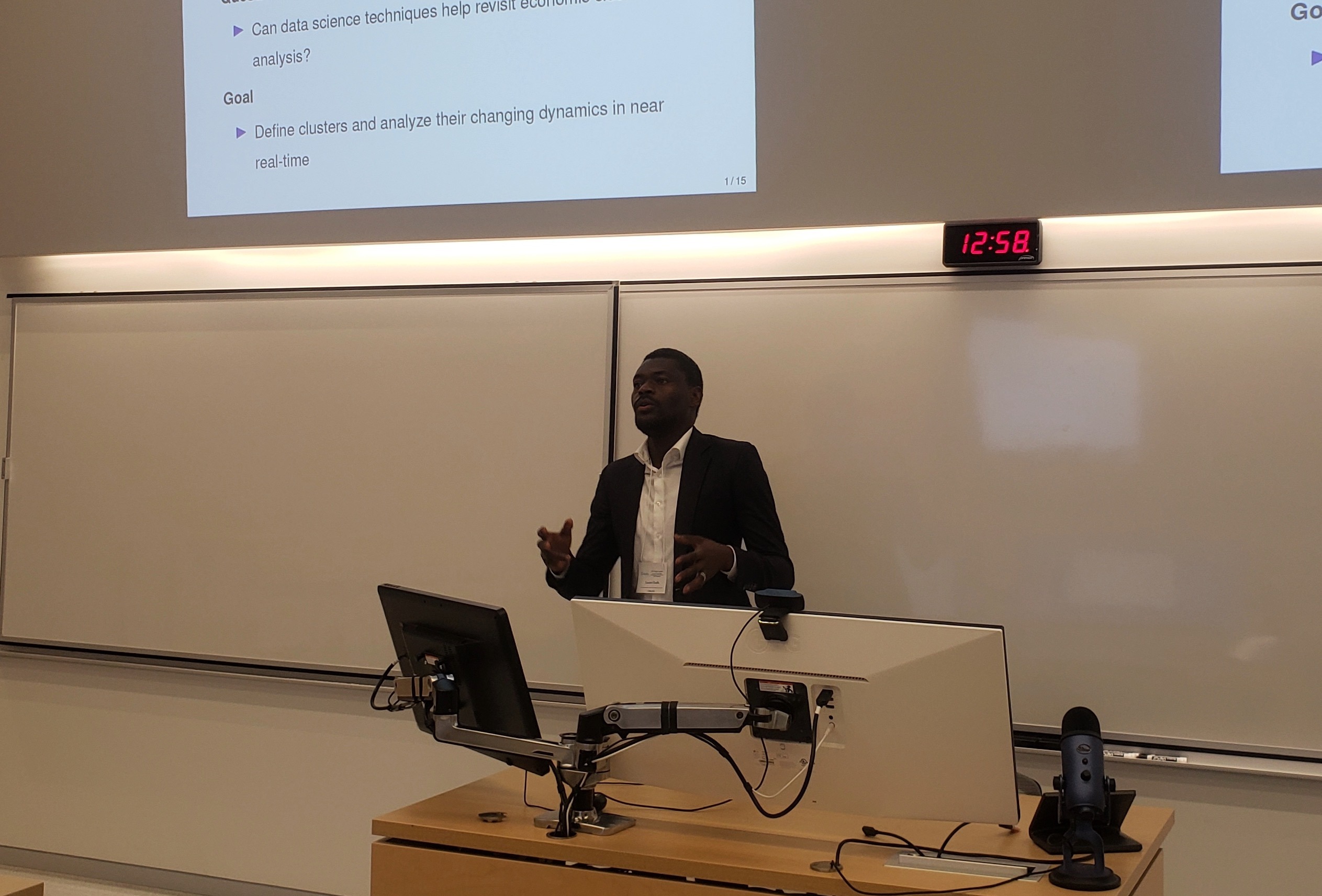
    On May 17, Lucien Chaffa presented his paper, co-authored with Thierry Warin, titled “Deciphering Economic Clusters in Real-time: Applying Machine Learning to Registre des entreprises du Québec Data” at the 63rd annual conference of the Société canadienne de science économique (SCSE). This event marks a major milestone for us as it showcased preliminary findings from our very first research paper to a group of eminent academics.

    Economic clusters are an integral dimension of our economic analysis in the bi-national St. Lawrence – Great Lakes region. Firms from an industry form linkages with firms from other industries, resulting in them colocating with each other. The grouping of industries into such clusters is useful to better understand the structure of regional economies and the industrial dynamics within them. Identifying the presence of clusters and subsequently analyzing their industrial composition, highlights the hidden interdependencies between firms and their economic impact at a very granular scale.

    Clusters have become a household tool for policymakers to enhance regional competitiveness. Yet, cluster theory and its definitions have often relied on a qualitative, case-study driven approach where empirical data is used to validate hypotheses in a region-specific context. With this paper, we operationalize our inductive approach by using data science methods to revisit economic phenomena. By using firm level data from the Registre des entreprises du Québec, we create a new quantitative measure to define clusters and analyze their changing dynamics in near real-time.

    The methodology and findings of this research paper will soon be published on our website. We invite you to refer to the following presentation for more detailed insights.

    Speaker(s)

    • Aïchata S. Koné

      CIRANO & GVCdtLab

    • Thierry Warin

      HEC Montréal, CIRANO, GVCdtLab & Digital Data Design (D^3) Institute at Harvard Business School

  • Introducing the SLGL dataHub

    Introducing the SLGL dataHub

    Event

    Introducing the SLGL dataHub

    On March 21, CIRANO’s Pole on Data Science for Trade and Intermodal Transportation held its annual conference on the theme of Data Science for St. Lawrence – Great Lakes: Innovation and Collaboration. The event brought together stakeholders from the government, industry, and academia, from both Canada and the US. The speakers presented and discussed how data science could help solve key trade and transportation issues in the binational St. Lawrence – Great Lakes (SLGL) region.

    The changing geopolitics, recovery from the COVID-19 pandemic and the rapidly evolving effects of climate change have enveloped the pace of globalization and its networks with tremendous uncertainty. With a combined current-dollar GDP of over $7.9 trillion in 2022, the SLGL region is an economic powerhouse with significant potential for sustained growth.

    The region offers policymakers an enticing opportunity for cross-border collaboration in delivering a stable and prosperous business environment in an increasingly challenging global landscape. Strengthening the resiliency of supply chains and devising a plan of action for disruptions to the region’s multimodal transportation network are essential steps toward this goal.

    The SLGL dataHub, an analytics platform and database, is being designed and developed to fulfill this very need. Our team presented an early version of the SLGL dataHub to the audience in attendance, showcasing the capabilities of digital twins in breaking down complexity with the use of data science.

    Using real-time data to create a digital projection of the bi-national economy, the SLGL dataHub will offer users granular firm-level insights and analysis. We study this region through four dimensions of international business literature which includes global value chains (GVCs), economic clusters, economic complexity and the gravity model.

    The digital twin uses advanced machine learning models to offer predictive modelling and risk analysis. By simulating scenarios such as blockades at important routes of international trade or port infrastructure being rendered inaccessible due to rising water levels, the SLGL dataHub will be able to effectively quantify impact on trade and transportation networks from such disruptions.

    Access to high quality and relevant data is a key factor influencing the efficacy of these simulations, which we continuously seek as we develop the SLGL dataHub.

    The SLGL dataHub will be made available to users in the coming weeks.

    Speaker(s)

    • Aïchata S. Koné

      CIRANO & GVCdtLab

    • Thierry Warin

      HEC Montréal, CIRANO, GVCdtLab & Digital Data Design (D^3) Institute at Harvard Business School

  • Breaking down Quebec’s industry life cycles

    Breaking down Quebec’s industry life cycles


    Event

    Breaking down Quebec’s industry life cycles

    The prosperity of industries significantly contribute to the socio-economic makeup of a region’s economy. Ensuring the continued growth of existent industries and fostering an ideal environment for the formation of complementary industries is paramount to a regions’s competitiveness. It also contributes to its attractiveness in the eyes of qualified workers who are an important ingredient for economic growth. Thus, to secure a continued inflow of capital and labour, policymakers, economic developers and industry stakeholders need to have a comprehensive understanding of the patterns of industry growth in their region.

    Analyzing the patterns of a region’s industry life cycles can offer meaningful insights that can be incorporated into strategies for fostering growth, mitigating decline and enhancing regional competitiveness. To put it plainly, industry life cycles measure the emergence, growth, maturity and decline of industries based on metrics such as revenues, market capitalization, firm entry and exits. Using data on firm entry and exits to measure industry life cycles captures the underlying health of the region’s economy which in itself is directly and indirectly affected by a wide range of variables.

    The SLGL dataHub will make it possible to visualize industry life cycles within the St. Lawrence and Great Lakes (SLGL) region, allowing users to not only study the size and composition of industries within the two Canadian provinces and eight US states but also compare the performance of specific industries across sub-national boundaries. In addition, firm level data will be used to map the location of the constituent firms within an industry to enable an analysis of its spread. When viewed through the lens of economic clusters, users will be able to identify clustering patterns of related industries and investigate their shifting geographic footprint over time.

    We use data from the Registre des entreprises (REQ), published by the government of Quebec, to visualize industry life cycles and perform geospatial mapping of industries in Quebec. Within the context of the study of industrial life cycles, REQ provides longitudinal data on enterprises registered in Quebec with information of their address, industry, number of employees (within a range), date of registration and date of exit. We use this data to analyze the number of firms within an industry, the average life span of firms within an industry and the rate of growth or decline within an industry both in spatial and temporal terms.

    Firms in the REQ dataset are each given a four-digit industry code, with the industry classification offering three levels of granularity. This granularity ranges from 75 groups of industries at the two-digit level, to 1,116 industries at the four-digit level.


    The computation of active firms in an industry during a year opens up the possibilities for data transformation. This can be found by adding the number of firms that have entered an industry during a year and subtracting the number of firms that have exited the industry over the same time period. Depending on the requirements of the researcher, the firms can also be further categorized by their number of employees.

    The above chart shows the shifting sectoral composition in the province from 1990 to 2022. It is pertinent to note that the chart represents the weight of active firms (with one or more employees) in an industry as a percentage of the whole economy during that year. Crucially, the total number of active firms has increased from 23,406 in 1990 to 98,913 in 2022. While we have only visualized industries at the two-digit level accounting for more than 1.5% of the overall industrial composition for the year, over all the years of study, this analysis underscores the potential for deriving valuable insights from this dataset.

    This visualization reveals how industries have evolved in response to external factors such as competition induced by globalization, targeted economic policies and technological change. As an example, it shows how the services aux entreprises industry has risen in importance from 1990 to 2022, doubling its share from about 7% to 14% of the total industrial composition. Policymakers can use this data to analyze the impact of industry specific policies, using the resultant insights to inform future policy interventions. The granularity of this dataset's industrial classification is matched with its geographic granularity, enabling the study of an industry at the provincial level, all the way down to the municipal level. In fact, policymakers can practically study the evolution of an industry within a specific neighbourhood in a municipality.


    To demonstrate this, we study the restaurant industry's life cycle at the municipal level. Since over half of Quebec's population live in just 16 municipalities, analyzing the pattern of the restaurant industry's life cycle within this geographical context becomes particularly interesting1. At the face of it, this industry would be particularly affected by factors such as population growth, density, economic development, tourism and changing lifestyles. However, external shocks and disruptions such as the COVID-19 pandemic can also have a significant impact on the aforementioned factors and consequently, on the industry.

    We can study the impact of these factors on the number of active firms in the restaurant industry at the three-digit level which includes firms in Services de restauration, Restaurants avec permis d'alcool, Restaurants sans permis d'alcool, Services de mets à emporter, Traiteurs and Cabanes à sucre. Visualizing this data reveals the particularly unique patterns of growth within the industry in each municipality. Interestingly, the industry seems to have peaked in 2016, with the COVID-19 pandemic having had an insignificant impact on the number of active restaurants since 2020. This provides an additional data point for the study of the pandemic's impact on this industry.


    This data can also be used to reveal the geographic shift of the restaurant industry in the province over time. The above maps reveal the geographic footprint of the industry at the municipalités régionales de comté (MRC) level between 2012 and 2022. At the MRC level, municipalities are grouped into 104 regions, rendering an optimal compromise between the macroscopic nature of administrative regions and the microscopic nature of municipalities. The tooltip over each MRC provides a four-digit level break down of the restaurant industry, providing insights into the changing composition of the industry over 10 years.

    As an example, the makeup of the restaurant industry in Montreal has significantly changed between 2012 and 2022. While the total number of active firms has grown from 1,544 in 2012 to 1,904 in 2022, restaurants avec permis d'alcool comprise only 46% of Montreal's restaurant industry, down from 66% in 2012. Restaurants sans permis d'alcool have grown their industry share from 21% in 2012 to 35% in 2022. Such insights not only unlock greater awareness for policymakers on matters relating to regulations, economic impact, public health and urban planning but also helps industry stakeholders gauge opportunities and spot changing consumer preferences.

    The overarching insights offered through the study of industry life cycles on the SLGL dataHub is as a consequence of crucial importance for regional economic development. In the face of dynamic global challenges, policymakers, economic developers and industry stakeholders can leverage this information to pave the way for sustained prosperity.

    (This article incorporates a portion of forthcoming research by Lucien Chaffa and Thierry Warin titled “Mapping economic evolution: Data science techniques unveil the impact of geographic clustering on industry life cycles in Quebec”)


    References

    1. Institut de la statistique du Québec (n.d.)

    Speaker(s)

    • Aïchata S. Koné

      CIRANO & GVCdtLab

    • Thierry Warin

      HEC Montréal, CIRANO, GVCdtLab & Digital Data Design (D^3) Institute at Harvard Business School

  • Input-output tables: The foundational bricks of the SLGL dataHub

    Input-output tables: The foundational bricks of the SLGL dataHub


    Event

    Input-output tables: The foundational bricks of the SLGL dataHub

    The world economy is a consequence of a complex amalgam of economic policies that together operationalize globalization. A distinctive attribute of its pervasiveness lies in the participation of industries in global value chains (GVCs) by adding value through the performance of a specific slice of activity for which they have an absolute or comparative advantage. Participation of industries in GVCs accounts for a significant and increasing share of international trade, with the OECD estimating that around 70% of global trade is associated with GVCs1. Driven by advances in technology and transportation, industries can strategically position themselves within these complex networks to create and deliver value. This provides a viable strategy for job creation and healthy economic growth.

    However, due to its inherently complex nature, understanding the networks of GVCs presents a significant challenge. Amidst the fog of uncertainty stemming from shifting geopolitics, the COVID-19 pandemic and climate change, vulnerabilities in the supply of strategic goods have become more so exposed. This has led to considerable scrutiny of the structure and resilience of supply chains, with dependencies on certain industries and countries being called into question. The implementation of policies aimed at controlling certain aspects of GVCs are becoming increasingly commonplace, risking the production of unintended consequences that reverberate globally. This necessitates a comprehensive understanding of supply chains, particularly focusing on the integration and interdependencies they create between industries and regions.

    Traditional measures of economics fail to accurately gauge the contribution made by an industry by its participation in a GVC. Instead, using of input-output tables (IOTs) effectively reveals inter-industry dependencies in the context of international trade. IOTs break down the total output produced by an industry into intermediate and final consumption, providing valuable insight into the dependencies required to produce its output. Understanding the output of an economy through this lens presents an accurate picture of the structure and composition of GVCs. To study the level of economic integration and the networks of interdependencies within the St. Lawrence – Great Lakes (SLGL) region, we employ the use of OECD’s Inter-Country Input-Output (ICIO) tables.

    OECD’s ICIO represents the most comprehensive and current sets of IOTs constructed to date, utilizing a slew of datasets. To contextualize the ICIO dataset to the bi-national SLGL region, we rely on sub-national IOTs, as the ICIO only measures trade dependencies at the national level. We use IOTs published by Statistics Canada and the U.S. Census Bureau to track the flow of trade among the two Canadian provinces and the eight US states. With the help of concordance, we harmonize the classification of industries with the ICIO which groups industries based on the 4th revision of the International Standard Industrial Classification of All Economic Activities (ISIC). However, these sub-national IOTs lack the requisite level of granularity on intermediate consumption at the industry level, necessitating computations on our part to make the data more meaningful. Crucially, stateior has been used to perform these computations for the eight US states. The matrix table below lists the source of data for each value within the IOT constructed for the SLGL dataHub.


    In essence, our IOT meticulously maps production and trade flows for forty-five industries producing goods and services on an annual basis from 2012 to 2020. These tables facilitate the study of trade within the bi-national SLGL region at the sub-national level. Beyond the SLGL region, our IOT covers forty three countries, including twenty-seven members of the EU and sixteen other major economies (Australia, Brazil, Canada, China, India, Indonesia, Japan, Mexico, Norway, Russia, South Korea, Switzerland, Taiwan, Türkiye, the United Kingdom and the United States) covering about 85 per cent of world GDP in 2022 (at current prices)2. Additionally, the table provides a categorization for the rest of the world to accommodate trade with countries beyond the IOT’s coverage.


    These IOTs serve as the foundational dataset of the SLGL dataHub, enabling the analysis of economic dynamics both within and beyond the SLGL region. The SLGL dataHub will continually be updated to incorporate new datasets, which, when combined with the IOTs, will be instrumental in designing new indicators aimed at revealing fresh insights.


    References

    1. OECD (n.d.)

    2. World Development Indicators

    Speaker(s)

    • Aïchata S. Koné

      CIRANO & GVCdtLab

    • Thierry Warin

      HEC Montréal, CIRANO, GVCdtLab & Digital Data Design (D^3) Institute at Harvard Business School


FR